Calculates the posterior of the linear predictor.
Usage
# S3 method for class 'blrmfit'
posterior_linpred(object, transform = FALSE, newdata, draws, ...)
Arguments
- object
fitted model object
- transform
logical (defaults to
FALSE) indicating if the linear predictor on the logit link scale is transformed withinv_logitto the 0-1 response scale.- newdata
optional data frame specifying for what to predict; if missing, then the data of the input model
objectis used- draws
number of returned posterior draws; by default the entire posterior is returned
- ...
not used in this function
Value
Matrix of dimensions draws by nrow(newdata)
where row correspond to a draw of the posterior and each
column corresponds to a row in newdata. The columns are
labelled with the row.names of newdata.
Details
Simulates the posterior of the linear predictor of the model
object for the specified data set.
Group and strata definitions
The groups and strata as defined when running the blrm_exnex
analysis cannot be changed at a later stage. As a result no
evaluations can be performed for groups which have not been present
in the data set used for running the analysis. However, it is
admissible to code the group (and/or stratum) column as a
factor which contains empty levels. These groups are thus
not contained in the fitting data set and they are assigned by
default to the first stratum. In addition priors must be setup for
these groups (and/or strata). These empty group (and/or strata)
levels are then allowed in subsequent evaluations. This enables the
evaluation of the hierarchical model in terms of representing a
prior for future groups.
Examples
.user_mc_options <- options()
## run single-agent analysis which defines blrmfit model object
example_model("single_agent", silent = TRUE)
## obtain posterior of linear prediction on 0-1 scale
post_prob_dlt <- posterior_linpred(blrmfit, TRUE, newdata = hist_SA)
## name columns to obtain nice bayesplot labels
colnames(post_prob_dlt) <- hist_SA$drug_A
library(bayesplot)
#> This is bayesplot version 1.15.0
#> - Online documentation and vignettes at mc-stan.org/bayesplot
#> - bayesplot theme set to bayesplot::theme_default()
#> * Does _not_ affect other ggplot2 plots
#> * See ?bayesplot_theme_set for details on theme setting
library(ggplot2)
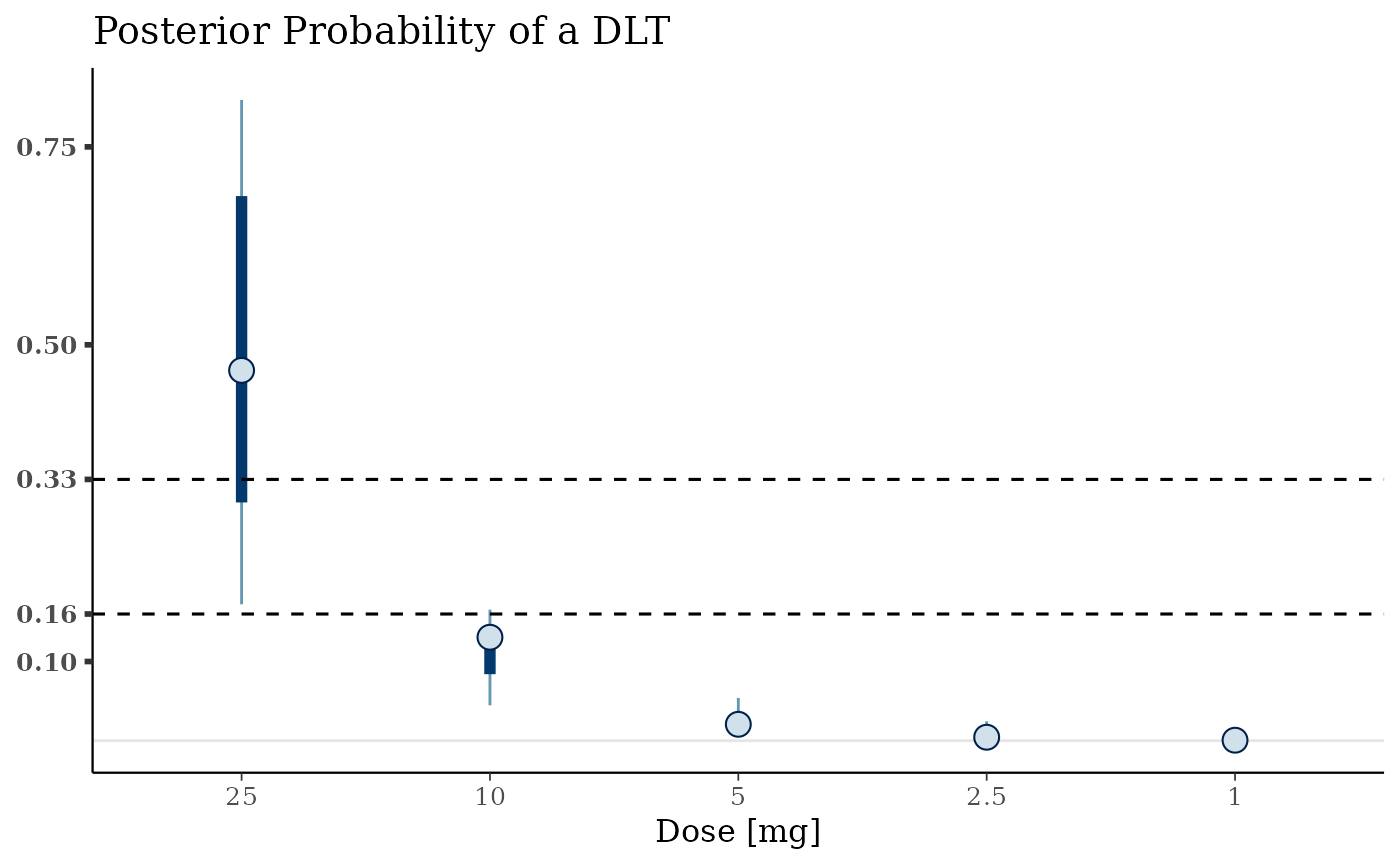
mcmc_intervals(post_prob_dlt, prob = 0.5, prob_outer = 0.95) +
coord_flip() +
vline_at(c(0.16, 0.33), linetype = 2) +
ylab("Dose [mg]") +
ggtitle("Posterior Probability of a DLT") +
scale_x_continuous(breaks = c(0.1, 0.16, 0.33, 0.5, 0.75))
#> Scale for x is already present.
#> Adding another scale for x, which will replace the existing scale.
 ## Recover user set sampling defaults
options(.user_mc_options)
## Recover user set sampling defaults
options(.user_mc_options)